
 EN
EN
 AR
AR
 NL
NL
 FR
FR
 DE
DE
 IT
IT
 NO
NO
 PL
PL
 PT
PT
 RU
RU
 ES
ES
 SV
SV
 IW
IW
 GA
GA
 MI
MI
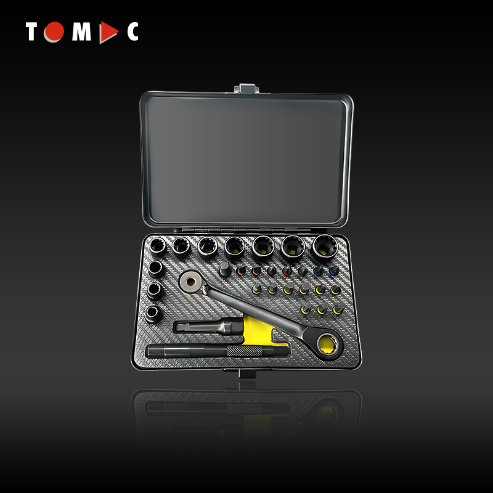
Understanding Ratchet Wrench Design for Tight Space Performance
Core Mechanics of a Ratchet Wrench and Its Advantages
What makes a ratchet wrench so useful is the clever internal pawl and gear setup inside it. This lets workers keep turning bolts and nuts without having to stop and reset the tool every time. Better quality wrenches typically have gears with anywhere from 72 to 120 teeth, allowing for really tight swings of just 3 to 5 degrees according to Norton's Machine Design book. Standard wrenches need about 30 degrees of space to work properly. The whole ratcheting system basically takes away the hassle of constantly picking up and moving the tool around after each twist. Mechanics working on cars or doing industrial repairs find this saves them a lot of back and forth motion. Some studies suggest it cuts down on repetitive movements by roughly two thirds compared to traditional wrenches.
How Ratchet Wrench Design Enhances Usability in Confined Spaces
When working in cramped quarters, engineers have come up with some clever ways to make ratchet wrenches work better. Most notably, they've developed tools with super slim heads and handles that can pivot when needed. Take those compact 72 tooth models with their thin 14mm heads. These babies can squeeze into spaces under 2.5cm wide, which matters a lot since parts in today's engines often sit just 1.8cm apart from each other. Some field tests actually showed that these specialized wrenches cut down on slippage problems by around 40% compared to regular wrenches that don't have a ratchet mechanism. And let's not forget about those offset handles either. They give mechanics extra reach angles, making it possible to turn bolts at up to 135 degrees in really tight spots where straight access isn't an option.
Swing Angle and Operational Efficiency: Key Performance Metrics
A tool’s swing angle directly determines its effectiveness in cramped environments:
- 5°–10° swing arc: Ideal for alternator bolt access or HVAC panel fasteners (requires 40% fewer turns than 15° models)
- 15°–25° swing arc: Suitable for general maintenance but struggles in confined spaces (23% slower operation)
Premium ratchet wrenches balance minimal swing angles with torque capacity—chrome-vanadium steel heads maintain 75 N·m strength despite their compact 6.3 cm lengths.
Top Ratchet Wrench Types for Confined Spaces
Flex-Head Ratchet Wrench: Precision and Adaptability in Tight Areas
The pivot mechanism in flex-head ratchet wrenches allows 30°–90° articulation, enabling access to recessed fasteners behind obstructions. Technicians report a 34% reduction in hand repositioning compared to fixed-head models when working on engine manifolds or transmission assemblies.
Mini or Stubby Ratchet Wrench: Compact and Lightweight Design Benefits
With 3’–6’ handle lengths and a total weight under 0.8 lbs (360 g), stubby wrenches excel in cabinetry or motorcycle repairs where lateral arm movement is restricted. Field tests show these tools require 29% less clearance than full-size counterparts while maintaining 70%+ torque efficiency.
Telescoping and Offset Ratcheting Wrenches for Deep Recessed Access
Telescoping handles extend 6’–14’ to reach suspension bolts through wheel wells, while 15°–60° angled heads bypass exhaust components during catalytic converter replacements. Offset designs reduce knuckle clearance requirements by 22% compared to straight models (Automotive Repair Quarterly 2023).
Ratcheting Box Wrench vs. Standard Ratchets: When to Use Each
| Feature | Ratcheting Box Wrench | Standard Ratchet |
|---|---|---|
| Torque Capacity | 180 ft-lbs+ (high fastener grip) | 90–120 ft-lbs (socket-based) |
| Work Angle | Fixed 15° access | 5°–10° swing |
| Fastener Security | Hexagonal head lock | Socket retention tabs |
| Use ratcheting box wrenches for high-stress suspension bolts and standard ratchets when working around delicate electrical components requiring precise torque control. |
Key Performance Factors: Swing Angle, Durability, and Motion Efficiency
How Minimal Swing Angles (5°–10°) Improve Functionality
The swing angle of a ratchet wrench—the amount of space needed to reset the tool—is what really makes it work well in cramped spots. Wrenches with smaller swing angles ranging from 5 to 10 degrees cut down on how much time mechanics spend moving their hands around by almost two thirds when compared to older models that require 30 to 45 degree arcs. This means technicians can tackle nuts and bolts even when there are obstacles blocking the way in places like under car engines without having to completely take off whatever they're working on first. What gives these modern wrenches their edge comes down to better designed pawls and gears inside. These tools often feature tiny teeth numbering somewhere between seventy two and ninety, which lets them make much finer turns while still getting all the power through to loosen or tighten those stubborn fasteners properly.
Gear Tooth Count and Its Impact on Ratcheting Smoothness
More teeth on gears generally means less friction and better torque distribution throughout the system. Take for example when comparing a gear with 90 teeth versus one with just 72 teeth. The bigger gear spreads out the workload over nearly a quarter more contact spots, which helps prevent those annoying slips we see under heavy loads. But wait there's a catch. Some recent research from mechanical engineers suggests that after hitting around 100 teeth, things start getting tricky. At that point, even tiny manufacturing differences matter a lot for how long these components will actually last in real world conditions.
Material Durability Versus Compactness Trade-offs
Premium chrome vanadium steel offers 18% greater yield strength (1,050 MPa) than standard carbon steel, enabling slimmer wrench profiles without sacrificing durability. This material science advancement allows compact 6mm-thick ratchet heads to withstand 200 Nm of torque—equivalent to bulkier designs from the previous decade.
High-Tooth-Count Gears vs. Torque Capacity: Balancing Precision and Power
Modern 72-tooth ratchets now match the torque capacity (250–300 Nm) of older 24-tooth models through case-hardened gear enhancements. This eliminates the traditional compromise between precision and power, with fatigue testing showing 15% longer lifespan in high-tooth designs under cyclical loading (ASTM F1940-23 standards).
Real-World Application: Using Ratchet Wrenches in Automotive Repair
Case Study: Flex-Head Ratcheting Wrenches in Modern Sedan Engine Bays
The engine compartments in modern sedans are giving even seasoned mechanics headaches these days. According to the latest Automotive Tool Efficiency Report from 2024, around eight out of ten repairs require getting at parts hidden behind all sorts of tightly packed systems. That's where flex-head ratchet wrenches come into play. These handy tools can twist their heads between 45 and 90 degrees, making them perfect for squeezing past tricky spots like turbocharger housings or steering column assemblies. Some field tests indicated that mechanics working on alternator replacements finished the job about 27 percent quicker when using these adjustable wrenches instead of traditional fixed-head versions. The main reason? Less time wasted moving tools around in those cramped spaces. Of course, actual results may vary depending on the specific vehicle model and workshop conditions.
Comparison with Socket Extensions and Universal Joints
While socket extensions and universal joints provide depth reach, they introduce two critical drawbacks in confined spaces:
- Increased Z-axis clearance: Stacked extensions raise tool height by 1.2"–3.5", risking interference with overhanging components
- Torque loss: Universal joints dissipate up to 15% of applied torque through pivot points
In contrast, low-profile ratchet wrenches maintain direct drive integrity while achieving similar access depths through optimized 72-tooth gear designs. Mechanics report 40% fewer rounded fasteners when using ratcheting wrenches versus extension-dependent setups in transmission work.
Mechanic Testimonials on Ease of Use in Confined Spaces
Replacing fuel injectors on those tight European engine blocks was a nightmare before, according to a mechanic who's worked on BMWs for over two decades. Back then, getting at those injectors meant tearing apart almost half the intake manifold. But nowadays? Just grab one of these new 10 degree swing angle ratchets and voilà! No need to mess with all those delicate secondary systems anymore. Pretty much everyone in the garage is talking about this shift too. A recent poll of around 1,200 techs showed that nearly eight out of ten have switched to ratcheting wrenches instead of their old socket sets when working under the hood. Makes sense really. These tools can hold that 35 foot pound torque even when there's barely an inch to move side to side, which comes in handy when servicing EV battery compartments where space is super limited.
Innovations and Best Practices for Effective Tight-Space Tool Use
Advancements in Ergonomic, Lightweight Ratchet Designs
Today's ratchet wrenches are made from lighter but tough materials such as magnesium aluminum alloys, cutting down their weight by around 18 to 23 percent while still holding up well over time according to a recent ToolTek study from last year. The new designs have curved handles covered in grippy polymer material which makes them much easier on hands when working for hours in tight spaces under engines. Tool makers manage to keep these wrenches small enough yet strong enough by using special hex shaped drives that spread out the pressure better when dealing with really heavy loads upwards of ninety foot pounds or more.
Integration of Magnetic Socket Retention and 360° Rotation
Hybrid designs now combine ratchet wrench mechanisms with neodymium magnetic sockets, eliminating 72% of accidental socket drops in overhead applications (Workshop Efficiency Report 2024). True 360° directional switches paired with 72-tooth gears enable full rotation in 5° increments—critical for maneuvering around hydraulic lines in tractor cabins or marine engine bays.
Smart Tools and Digital Integration: Future Outlook for Ratchet Wrenches
IoT-enabled ratcheting systems now track torque application through embedded microsensors, alerting users via haptic feedback when exceeding preset thresholds. While only 12% of professional mechanics currently use Bluetooth-connected tools, industry projections show 300% adoption growth by 2027 for digital torque logging in aviation maintenance scenarios.
Strategies for Maximizing Ratchet Wrench Use in Tight Spaces
- Lubrication Cadence: Rebuild ratchet heads every 1,500 cycles using PTFE grease to maintain <5° swing angles
- Access Planning: Combine offset wrenches with 8mm socket extensions for recessed motorcycle engine bolts
- Force Optimization: Apply inward pressure on wrench heads during clockwise turns to stabilize thin-walled sockets
These techniques reduce component damage rates by 34% compared to conventional ratcheting methods in industrial machinery repairs.
FAQ
- What's the main advantage of using a ratchet wrench? Ratchet wrenches allow continuous turning without resetting, significantly improving efficiency by reducing repetitive movements, especially in tight spaces.
- Why are slim heads important in ratchet wrench design? Slim heads allow the wrench to fit into confined spaces, making them essential for modern vehicles with tightly packed components.
- How does tooth count affect ratchet wrench performance? A higher tooth count typically means smoother operation with less swing angle needed, which is beneficial in restricted areas.
- Are IoT-enabled ratchet wrenches effective for everyday use? While IoT features provide advanced monitoring and precision, they're currently more beneficial in specialized fields like aviation maintenance but are expected to become more common.
- What materials are best for durable ratchet wrenches? Chrome vanadium steel is ideal due to its high yield strength and ability to maintain compact profiles without sacrificing durability.
Table of Contents
- Understanding Ratchet Wrench Design for Tight Space Performance
- Top Ratchet Wrench Types for Confined Spaces
- Key Performance Factors: Swing Angle, Durability, and Motion Efficiency
- Real-World Application: Using Ratchet Wrenches in Automotive Repair
- Case Study: Flex-Head Ratcheting Wrenches in Modern Sedan Engine Bays
- Comparison with Socket Extensions and Universal Joints
- Mechanic Testimonials on Ease of Use in Confined Spaces
- Innovations and Best Practices for Effective Tight-Space Tool Use
- FAQ