
 EN
EN
 AR
AR
 NL
NL
 FR
FR
 DE
DE
 IT
IT
 NO
NO
 PL
PL
 PT
PT
 RU
RU
 ES
ES
 SV
SV
 IW
IW
 GA
GA
 MI
MI
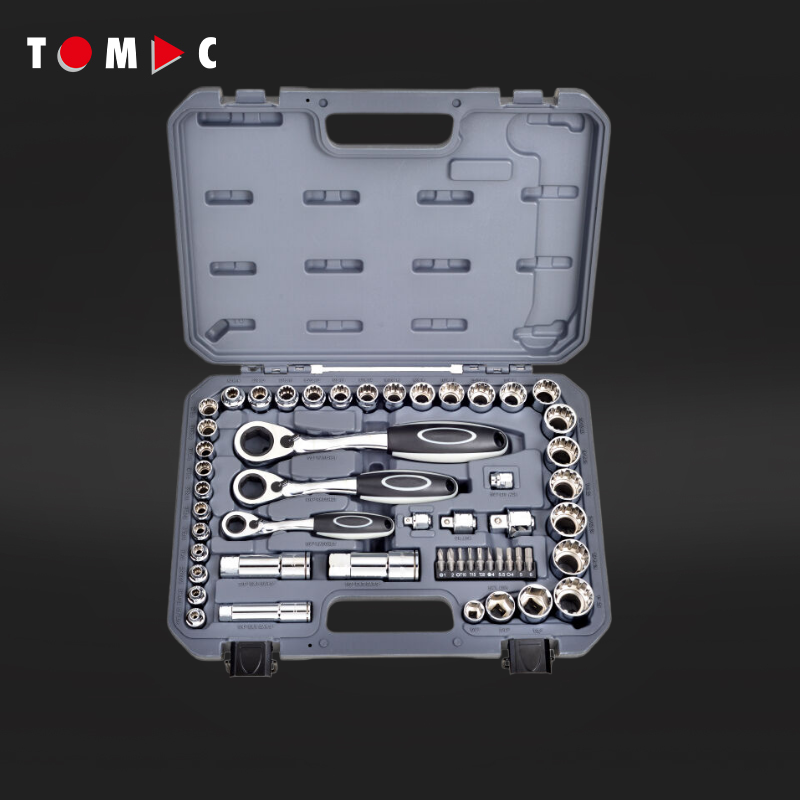
The 1/2" Drive as the Workhorse Platform
A 1/2" drive socket wrench set handles the heavy end of automotive fastening — lug nuts at 110–150 Nm, suspension bolts at 80–200 Nm, and drivetrain fasteners where thread diameters reach M14–M24. The drive square transfers torque loads that would shear smaller drives, making it the default for any fastener requiring breaker-bar effort or impact gun application. Socket coverage spans 10mm to 32mm in metric and corresponding SAE sizes.
A transmission repair shop in Barcelona standardized technician workstations with individual 1/2" sets after documenting that technicians lost approximately 12 minutes per shift searching for borrowed sockets from shared sets. The roughly $200 per-workstation investment recovered its cost within three weeks through reduced non-productive time.
Expanding Capability Through Accessory Integration
Chrome vs. Impact Sockets
Standard chrome sockets must never be used on impact guns — the brittle chrome layer fractures under impact loading, sending sharp fragments across the work area. Impact sockets use softer, thicker-walled Cr-Mo steel with black oxide finish absorbing impact energy through elastic deformation.
A 1/2" drive socket wrench set that includes both types equips technicians for the full workflow: break loose with impact, then switch to chrome sockets on a torque wrench for final tightening. The color differentiation provides instant identification, reducing cross-contamination risk that damages both fasteners and tools.
Extensions and Adaptors
Extension bars in 75mm, 150mm, and 250mm lengths extend reach into deep engine bays. Wobble extensions with slightly relieved drive squares allow 5–10 degrees of socket articulation around obstacles. Locking extensions with spring-loaded detent balls prevent socket separation during extraction.
Universal joint adaptors provide up to 30 degrees of angular offset but introduce efficiency losses — the greater the angle, the more torque consumed by joint friction. For high-torque applications, use universal joints only for breaking fasteners loose; final tightening requires straight extensions for accurate torque transmission.
Breaker Bar and Ratchet Selection
A 24-inch breaker bar amplifies input force through leverage, generating breakaway torque for corroded bolts. The fixed head eliminates the ratchet mechanism as a failure point. The ratchet should feature a fine-tooth mechanism — 72-tooth minimum — providing the small swing arc needed in confined wheel wells. Quick-release buttons simplify one-handed socket changes. Comfort-grip handles reduce fatigue during repetitive suspension work.
Application-Specific Techniques
Wheel Service Protocol
Impact sockets on an impact gun remove lug nuts in seconds. Chrome sockets on a torque wrench reinstall them to manufacturer specification — typically 110–140 Nm — following a star-pattern sequence. Lug nut sockets with protective plastic sleeves prevent alloy wheel scratching, a cosmetic concern generating customer complaints more reliably than mechanical faults.
Suspension and Steering Work
Ball joint press adaptors, tie rod end sockets, and strut nut sockets extend the 1/2" set into specialty suspension territory. These task-specific sockets handle the oversized fasteners unique to suspension components where standard 6-point and 12-point sockets cannot engage.
Heavy Equipment Applications
Tractors and construction equipment use M16–M36 fasteners where 1/2" drive reaches its dimensional limits. Step-up adaptors to 3/4" drive allow powering larger sockets, though torque transmission drops. For sustained heavy-equipment work, a dedicated 3/4" drive set is correct — the 1/2" set serves smaller surrounding fasteners.
Maintenance and Tool Life
The broached hex opening wears gradually, with wear concentrated at fastener flat contact points. A worn socket applies force to fastener corners — the rounding mechanism. Inspect commonly used sizes (10mm, 13mm, 17mm, 19mm) monthly. Ratchets accumulate pawl and gear tooth wear, eventually producing skip-and-slip behavior. Rebuild kits restore mechanism function. A ratchet requiring more than 15 degrees before engagement needs service before failure under load.
Frequently Asked Questions
What socket sizes should a professional 1/2" drive set include?
Metric coverage from 10mm to 32mm with shallow and deep sockets, plus spark plug sockets in 16mm and 21mm. SAE coverage from 3/8" to 1-1/4" for shops servicing American vehicles. Shanghai Tomac Tools offers sets spanning 45-piece starter kits to 115-piece comprehensive configurations.
Why should chrome and impact sockets not be intermixed?
Chrome sockets on impact guns risk the hard chrome layer fracturing under impact loading, creating sharp fragments at dangerous velocities. Impact sockets use softer Cr-Mo steel with black oxide finish. The visual distinction helps technicians select the correct socket for each application.
How does a fine-tooth ratchet benefit 1/2" drive work?
Fine-tooth ratchets provide a 5-degree or less swing arc, enabling rotation where coarse-tooth ratchets require more handle movement than clearance allows. The smaller engagement angle reduces reversing force and increases usable positions in confined spaces.
What is the practical torque limit for 1/2" drive hand tools?
Manual ratchets and breaker bars safely transmit approximately 300–400 Nm before drive square yielding risks. Impact guns deliver 600–1,000+ Nm through impact sockets designed for this loading. Sustained torque above 300 Nm warrants upgrading to 3/4" drive.
How should distributors position 1/2" drive sets for professional customers?
Position as complete systems including chrome and impact sockets, extensions, universal joints, and specialty sockets. Customers evaluating component prices perceive higher cost than those evaluating productivity value — a complete system eliminating work stoppages for missing tools.
What causes 1/2" drive ratchet failure and how is it prevented?
Pawl and gear wear from repeated loading causes skip-and-slip. Overloading beyond torque rating — using cheater pipes — causes catastrophic gear tooth breakage. Using a breaker bar for initial break-loose torque and reserving the ratchet for fastener running preserves mechanism life indefinitely.