
 EN
EN
 AR
AR
 NL
NL
 FR
FR
 DE
DE
 IT
IT
 NO
NO
 PL
PL
 PT
PT
 RU
RU
 ES
ES
 SV
SV
 IW
IW
 GA
GA
 MI
MI
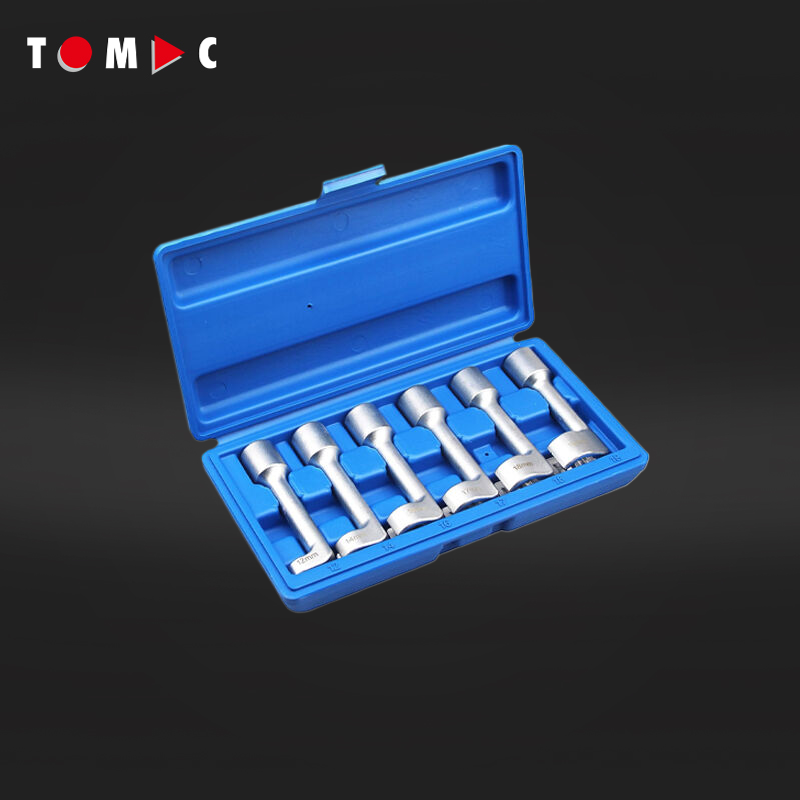
Understanding the 1/4" Drive Niche
A 1/4" drive socket wrench set occupies the precision end of the automotive tool spectrum. The compact drive square limits torque to approximately 20–30 Nm — a deliberate restriction preventing over-tightening fasteners designed for specific clamping loads. The drive size naturally restricts application to the 4–14mm range, where engine bay trim, interior panels, electronic modules, and motorcycle components concentrate their hardware.
Confusing a 1/4" set's purpose with that of 3/8" or 1/2" drive leads to the two most common failure modes: applying excessive torque that rounds fastener heads or cracks thin-walled sockets, and avoiding the set entirely for tasks within its capability out of habit.
A German workshop standardized each technician workstation with a dedicated 1/4" set after identifying that technicians used 3/8" ratchets on M6 and M8 interior fasteners, resulting in five stripped dashboard mounting points across three months of warranty work. After standardization, the shop recorded zero stripped interior fasteners over twelve months — the smaller drive enforced the lower torque limit fasteners required.
Where the 1/4" Set Excels
Interior and Dashboard Work
Modern vehicle interiors assemble from dozens of M4–M6 fasteners securing infotainment screens, climate modules, gauge clusters, and trim panels. These thread into plastic bosses or sheet metal clips with only 3–5 turns of engagement. A 1/4" socket wrench set with a 72-tooth ratchet providing 5-degree swing arc accesses fasteners behind dashboard structures where handle movement is limited to 20–30 degrees.
Deep sockets reach fasteners recessed into narrow channels. The shallow socket depth of roughly 15–20mm slides into spaces where 3/8" sockets cannot physically fit regardless of extension length.
Engine Bay Sensors and Electronics
Modern engines surround themselves with sensors — camshaft position, crankshaft position, oxygen, mass airflow — each secured by small fasteners in locations chosen for sensor function rather than access. The compact ratchet head reaches under intake manifolds and behind cylinder heads where larger tools contact adjacent components before socket seating.
The torque limitation prevents sensor housing damage. Many sensors mount with specified values of 8–15 Nm. A 3/8" ratchet generates sufficient leverage to routinely exceed these values, cracking flanges or stripping housing threads.
Motorcycle and Powersports Applications
Motorcycle engines and bodywork use M5–M10 fasteners with torque values at 5–25 Nm — squarely in 1/4" territory. The compact size fits frame openings and around fairing mounts where stubby 3/8" ratchets lack clearance. Hex bit sockets cover the Allen-head fasteners common on European and Japanese brands.
Set Composition and Quality Indicators
A professional-grade set should include metric sockets from 4mm to 14mm in shallow and deep configurations, a 72-tooth ratchet, extensions in 50mm, 100mm, and 150mm lengths, a universal joint, and a spinner handle for rapid running. Cr-V (chrome vanadium) steel with satin chrome finish indicates professional material and corrosion resistance. Laser-etched size markings readable after years of solvent exposure distinguish professional tools from consumer alternatives where markings fade within months.
Shanghai Tomac Tools produces 1/4" drive sets from 44-piece compact cases to 85-piece comprehensive kits with bit sockets and specialty accessories in Cr-V steel with CE certification.
Molded cases with individual socket positions allow visual inventory in seconds — a missing 10mm is immediately obvious. This matters in professional environments where a socket dropped into an engine bay creates both a foreign object risk and a productivity delay.
Pairing the set with a 1/4" torque wrench for final tightening eliminates the primary failure mode — over-torquing — by introducing measurement replacing subjective feel. Teams adopting this combination report measurable reductions in warranty claims related to stripped or loose fasteners.
Frequently Asked Questions
What fastener sizes can a 1/4" drive socket wrench set handle?
Standard sets cover 4mm to 14mm, handling M3 through M10 fasteners. The practical torque limit of 20–30 Nm makes the set ideal for interior trim, sensors, electronics, and motorcycle applications. Above M10 or 30 Nm, 3/8" or 1/2" drive provides necessary capacity.
How does a 72-tooth ratchet improve access in tight spaces?
A 72-tooth ratchet provides a 5-degree swing arc — the minimum handle movement to engage the next tooth. In confined spaces limiting movement to 15–20 degrees, a 72-tooth delivers 3–4 usable clicks while a 36-tooth with 10-degree arc delivers only 1–2. The difference determines whether fasteners can be tightened without removing surrounding components.
Should a 1/4" set include both shallow and deep sockets?
Yes. Shallow sockets access fasteners near obstructions. Deep sockets reach recessed positions and accommodate protruding stud threads. Shanghai Tomac Tools offers configurations from shallow-only starter kits to comprehensive sets with both depths and hex bit accessories.
Can a 1/4" drive set replace a 3/8" drive set?
No. The drive sizes serve complementary purposes. The 1/4" handles precision, low-torque applications where access is restricted. The 3/8" covers the mid-range from 8–19mm at 20–100 Nm. A complete workshop equips technicians with both, plus 1/2" for suspension and drivetrain fasteners exceeding 100 Nm.
What material quality indicates a professional-grade 1/4" socket set?
Cr-V steel with satin chrome finish, laser-etched size markings, and DIN/ISO dimensional compliance. The ratchet should feature a quick-release button, fine-tooth mechanism, and ergonomic handle. CE certification confirms compliance with European safety and quality standards.
How does a 1/4" drive set reduce warranty repair frequency?
The physical torque limitation prevents over-tightening fasteners in plastic, aluminum, and thin sheet metal applications where specified torque is 5–15 Nm. Over-torquing with larger drives causes stripped threads and cracked housings. The drive size itself acts as a mechanical torque limiter through tool geometry rather than technician discipline.